
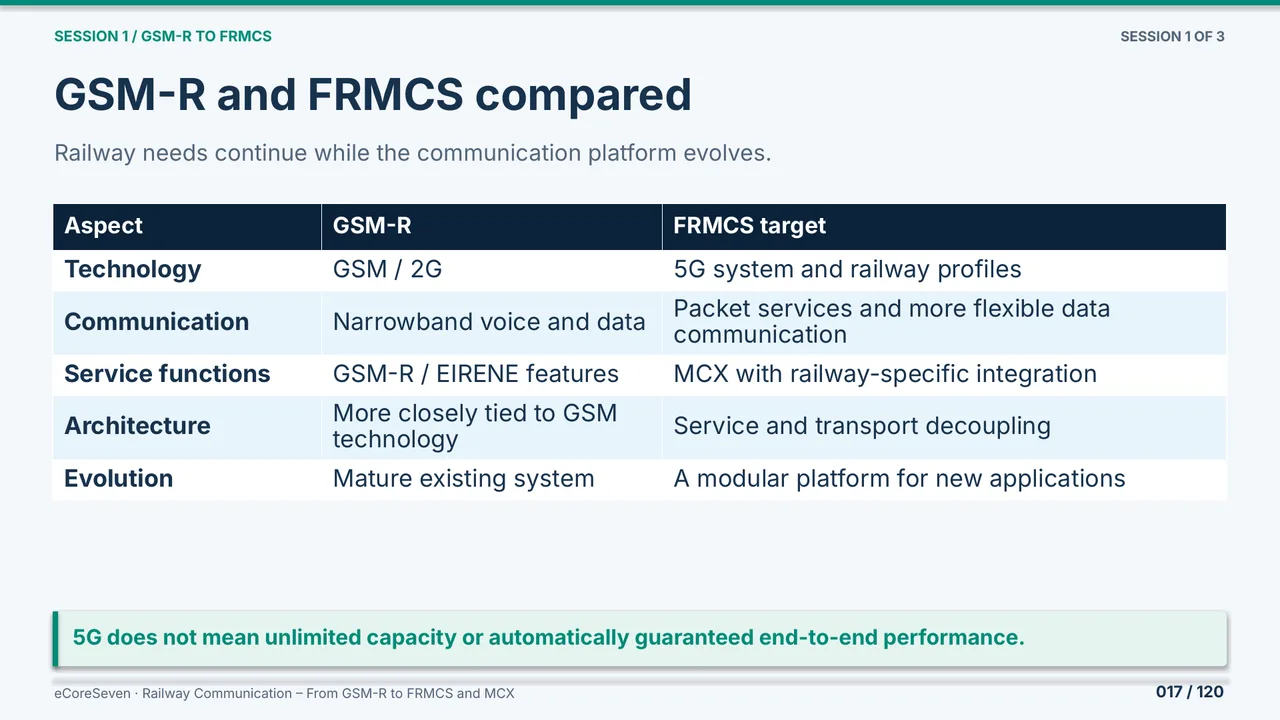
GSM-R and FRMCS side by side
| Aspect | GSM-R | FRMCS |
|---|---|---|
| Technology basis | 2G GSM, adapted for railways | 5G system with railway profiles |
| Voice | Circuit-switched calls; group calls (VGCS), broadcast (VBS), Railway Emergency Call | MCPTT over IP: group and private calls with floor control, priorities, emergency |
| Data | Narrowband; circuit-switched bearer for ETCS | Packet data with QoS; MCData messages, files and IP connectivity |
| Video | Not supported | MCVideo |
| Architecture | Services closely tied to the GSM technology | Service stratum (MCX) decoupled from transport stratum (5G) |
| Onboard | Cab radio and ETCS data radio | Onboard gateway and radio functions with OBAPP and OBRAD interfaces |
| Spectrum (EU) | 876–880 / 921–925 MHz (extended band 873–876 / 918–921 MHz) | 874.4–880.0 / 919.4–925.0 MHz (FDD) and 1900–1910 MHz (TDD) |
| Status | Mature system in operation; support limitations expected around 2035 | First implementable specification set (version 3) planned for 2027 |
The comparison shows the architectural direction rather than every optional feature. Interoperability comes from compatible profiles and successful verification – not from using the same generation number.
What stays the same
The operational needs of the railway do not change with the technology. Drivers and signallers still need fast, reliable voice with the right groups and emergency priority. Train control still needs a dependable bearer. Railway addressing – reaching “the driver of train 1234” or “the responsible signaller here” – remains essential. FRMCS has to preserve these functions while enabling more.
What really changes
From circuit-switched to packet-based
GSM-R voice is closely associated with circuit-switched operation. In FRMCS, voice, data and video are IP packets carried with defined QoS. The 5QI values for mission-critical push to talk are standardised: 65 for voice and 69 for signalling; MCVideo uses 67 and MCData 70. Packet technology does not create unlimited capacity, though: spectrum, coverage, bandwidth and priority rules still limit performance.
Services decoupled from transport
FRMCS places the mission-critical services in a service stratum above the 5G transport. Railway applications use these services through defined interfaces (OBAPP on the train, TSAPP on the ground), so that radio technology can change without changing every application.
A new onboard architecture
Instead of a cab radio for voice and a separate data radio for ETCS, FRMCS defines an onboard system with a gateway function and radio functions, separated by the OBRAD reference point. See OBAPP and OBRAD explained.
Coexistence and interworking during migration
Coexistence and interworking solve different problems. Coexistence allows both systems to operate at the same time, with spectrum and operational coordination. Interworking lets defined functions – such as group calls between a GSM-R and an FRMCS user – cooperate across the systems. That requires consistent addresses, groups, priorities and service states, and it does not mean that every GSM-R service has a perfect FRMCS counterpart.
What this means for your project
- Inventory your applications, vehicles and infrastructure and the baselines they depend on.
- Plan laboratory and pilot testing early – conformance, interoperability and performance evidence takes time.
- Define the coexistence period and the interworking scenarios you actually need.
- Train your teams: FRMCS combines railway, 5G and mission-critical service know-how.
Learn FRMCS and MCX hands-on
Online course “Railway Communication – From GSM-R to FRMCS and MCX”, including the practical module “MCX in Practice”: 90 minutes of video, 2 days in our online MCX lab and a certificate. €490 per participant.
See the course