
The three MCPTT KPIs
| KPI | Measured from → to | Requirement (3GPP TS 22.179) |
|---|---|---|
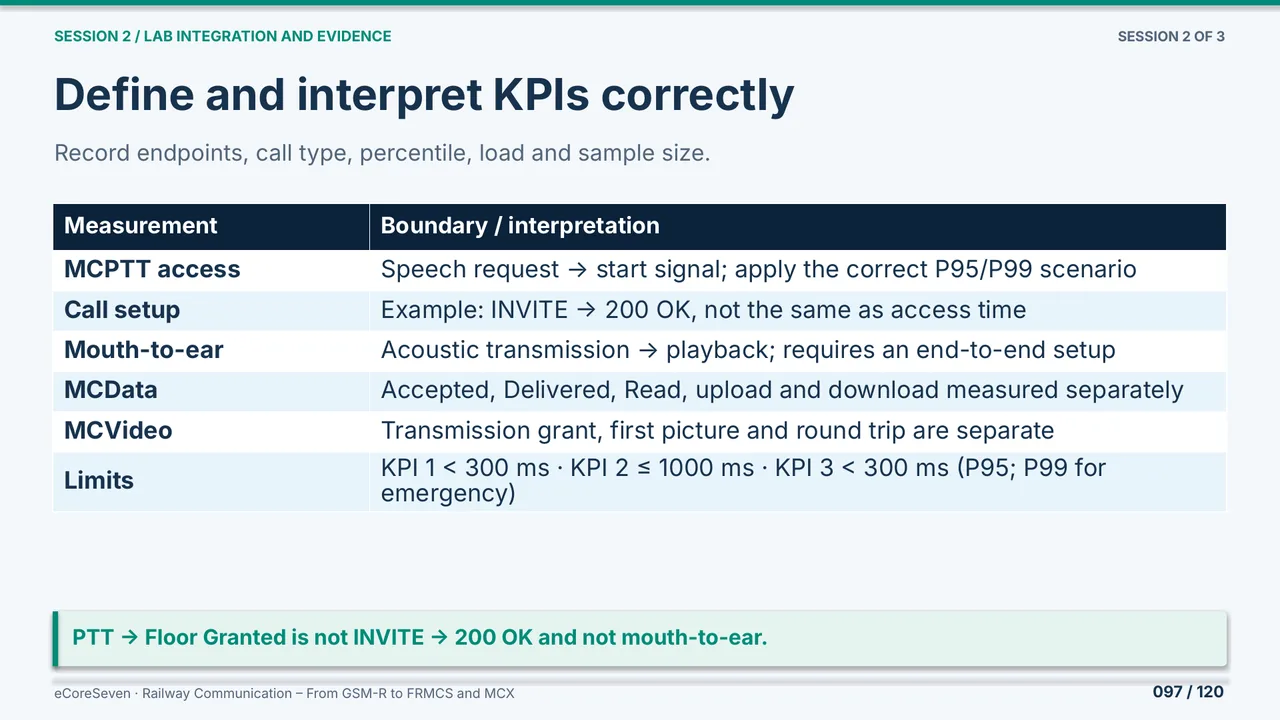
| KPI 1 · MCPTT access time | Push-to-talk request → permission to speak, in an already established call | < 300 ms for 95 % of requests |
| KPI 2 · End-to-end MCPTT access time | Push-to-talk request → permission to speak, including call setup (and acknowledgement from the receiving side, if required) | < 1000 ms |
| KPI 3 · Mouth-to-ear latency | Speech into the sending device → sound played on the receiving device | < 300 ms for 95 % of voice bursts |
The requirements apply under defined conditions and, for emergency cases, with stricter percentiles. Always state which requirement and which scenario you are testing against.
KPI 1: MCPTT access time
The time from the moment the user presses the push-to-talk button in an already established call until the system indicates that the user may speak. In protocol terms, it ends with the floor grant from the floor control server – not with the SIP call setup. If the first invitation carries an implicit floor request, the caller can speak without a separate request; your measurement must reflect which procedure was used.
KPI 2: End-to-end MCPTT access time
This KPI covers the case where the call does not exist yet: it runs from the push-to-talk request to the signal to start speaking and includes the call establishment – and, where required, the acknowledgement from the receiving side. It is therefore longer than KPI 1 and depends on call setup and the receiving clients.
KPI 3: Mouth-to-ear latency
The delay of the voice itself, from speaking into the microphone to hearing it at the receiver. It includes codec processing, packetisation, transport, jitter buffering and playback. A fast floor grant says nothing about mouth-to-ear latency – it needs an acoustic or audio-path measurement, not only packet traces.
How to measure MCPTT KPIs correctly
- Fix the boundaries: record exactly which event starts and stops each measurement.
- Use percentiles, not averages: the requirement is on the 95th percentile; averages hide outliers.
- Enough samples: five calls teach the method; an acceptance decision needs a statistically meaningful number.
- Defined conditions: state load, radio conditions, backhaul and any transcoding.
- Check QoS: verify that voice and signalling really get the intended treatment (5QI 65 and 69 in 5G).
- Report failures too: denied or lost floor requests and failed calls belong in the report, not only successful timings.
Beyond MCPTT: MCData and MCVideo
The same discipline applies to the other services. For MCData, “accepted”, “delivered” and “read” are separate events, and file upload and download are measured separately. For MCVideo, permission to transmit, first decodable picture and round trip are different measurements – permission is a signalling event, the first picture a media event.
Practise KPI measurement
In session 3 of our FRMCS training you run a KPI measurement in the online MCX lab, read the test report with percentiles and verdicts, and learn why lab values demonstrate the method but are not performance figures of real equipment.
Learn FRMCS and MCX hands-on
Online course “Railway Communication – From GSM-R to FRMCS and MCX”, including the practical module “MCX in Practice”: 90 minutes of video, 2 days in our online MCX lab and a certificate. €490 per participant.
See the course