
Why railways need a successor to GSM-R
GSM-R adapted the second-generation mobile system to railway operation. It carries driver–signaller voice, railway emergency calls and the radio link for ETCS Level 2 train control. Two drivers push the migration: the 2G technology is ageing, which creates long-term support and equipment lifecycle concerns, and railway digitalisation needs far more flexible data communication than GSM-R can offer.
Support limitations for GSM-R are expected around 2035. This is a planning assumption that encourages early preparation – not one binding shutdown date for every country. Actual transition plans depend on national arrangements, fleets, suppliers and operational readiness.
FRMCS is more than a new radio
FRMCS is often described as “5G for railways”, but that is only one part. The system combines three elements:
- Transport: 5G (and the related 3GPP system) provides connectivity, mobility and quality of service.
- Services: the mission-critical services MCPTT (push to talk), MCData and MCVideo provide controlled group speech, data and video.
- Railway requirements: UIC specifications define how railway applications use these capabilities – addressing, priorities, interfaces and operational behaviour.
The goal is a modular architecture: communication technology can evolve without forcing every railway application to change at the same time.
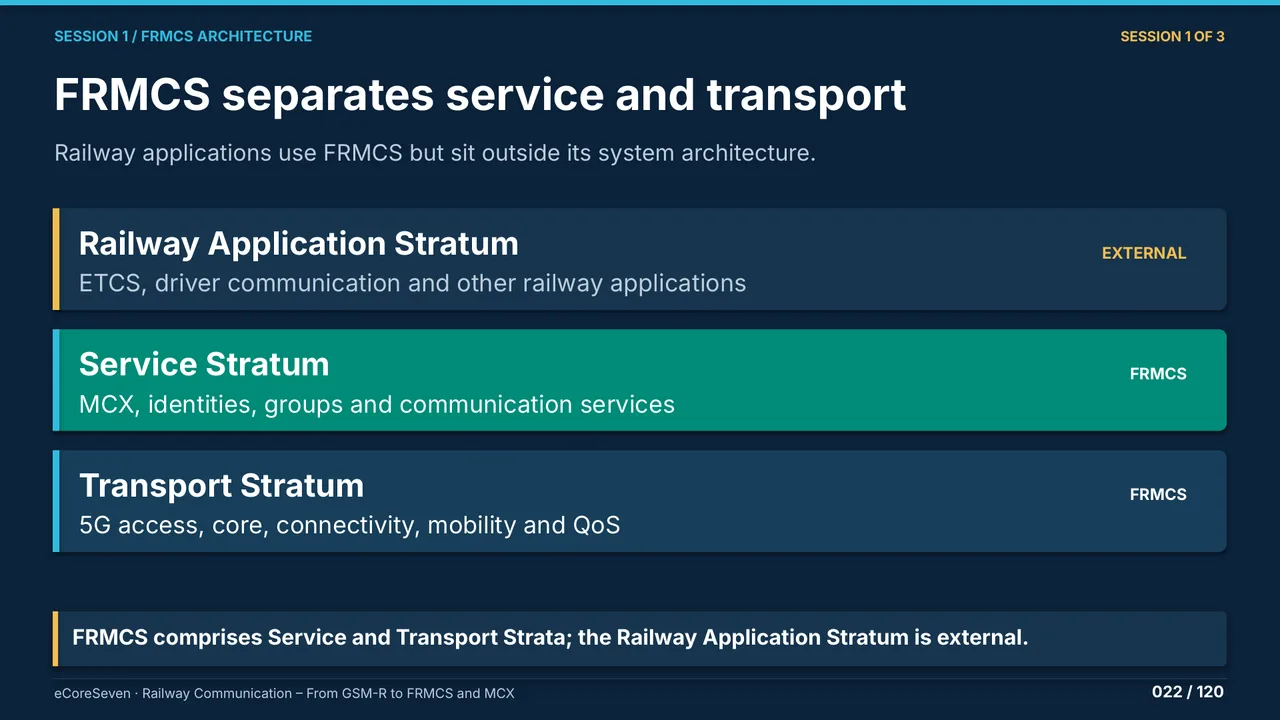
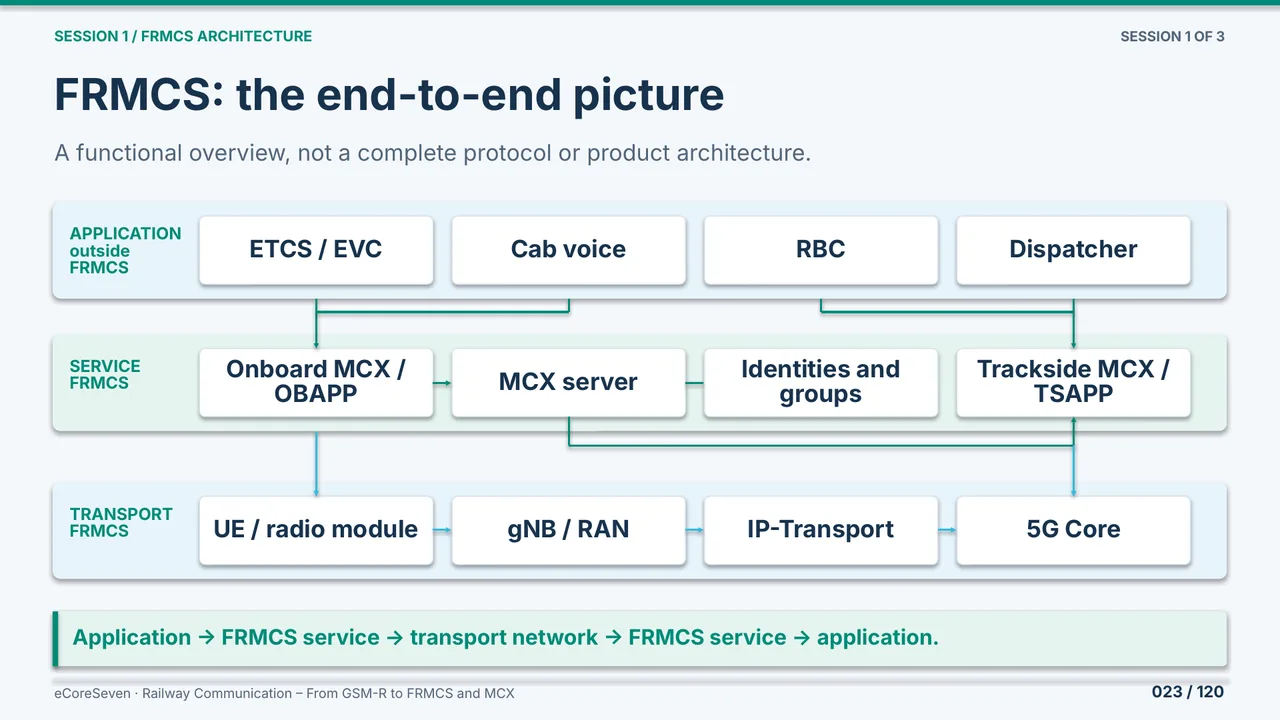
The architecture: application, service and transport
FRMCS separates three views. Railway applications such as ETCS, cab voice or the dispatcher sit above the communication system. The service stratum provides communication functions, identities, groups, permissions and service behaviour – this is where MCX lives. The transport stratum provides 5G access, the 5G core, IP transport, mobility and QoS.
This separation allows both layers to evolve independently, but it does not remove end-to-end responsibility: an application can still fail when the transport works but its service identity, interface binding or session state is wrong.
On board the train: gateway, radio, OBAPP and OBRAD
Onboard FRMCS is more than a router with a modem. Railway applications connect to the onboard system through the OBAPP interface; inside the onboard system, OBRAD separates the gateway function from the radio function. On the ground, TSAPP connects trackside applications. We explain these interfaces in detail in OBAPP and OBRAD explained.
Spectrum for FRMCS in Europe
The EU has harmonised two bands for railway mobile communication: a paired band at 874.4–880.0 MHz and 919.4–925.0 MHz (frequency division duplex) and an unpaired band at 1900–1910 MHz (time division duplex). Radio modules and base stations must support the required band and mode; national assignment, coexistence with GSM-R and route coverage still need engineering.
Who defines FRMCS – and when is it ready?
UIC develops the railway requirements, ETSI publishes the FRMCS system and interface specifications and 3GPP specifies 5G and the mission-critical services. Protocol conformance test specifications exist for MCX clients and, since early 2026, for the MCPTT and MCData application servers (ETSI TS 104 147 series and related).
The sector plans the first implementable specification set – FRMCS version 3 – for 2027, followed by its inclusion in the European regulatory framework. Specification, product availability, regulatory reference and operational approval are different milestones; for any project, establish the exact baseline you are working with.
Migration: coexistence before replacement
Migration starts with an inventory of applications, vehicles, infrastructure and baselines, followed by laboratory and pilot testing. During a coexistence period GSM-R and FRMCS operate side by side; interworking lets defined functions such as group calls cooperate across both systems. Only after the required evidence and operational decisions is the old system retired. Read the details in GSM-R vs FRMCS.
Learn FRMCS and MCX hands-on
Online course “Railway Communication – From GSM-R to FRMCS and MCX”, including the practical module “MCX in Practice”: 90 minutes of video, 2 days in our online MCX lab and a certificate. €490 per participant.
See the course